

mardi, 23 décembre 2025
23122025 (Dinhut, Kincaid)
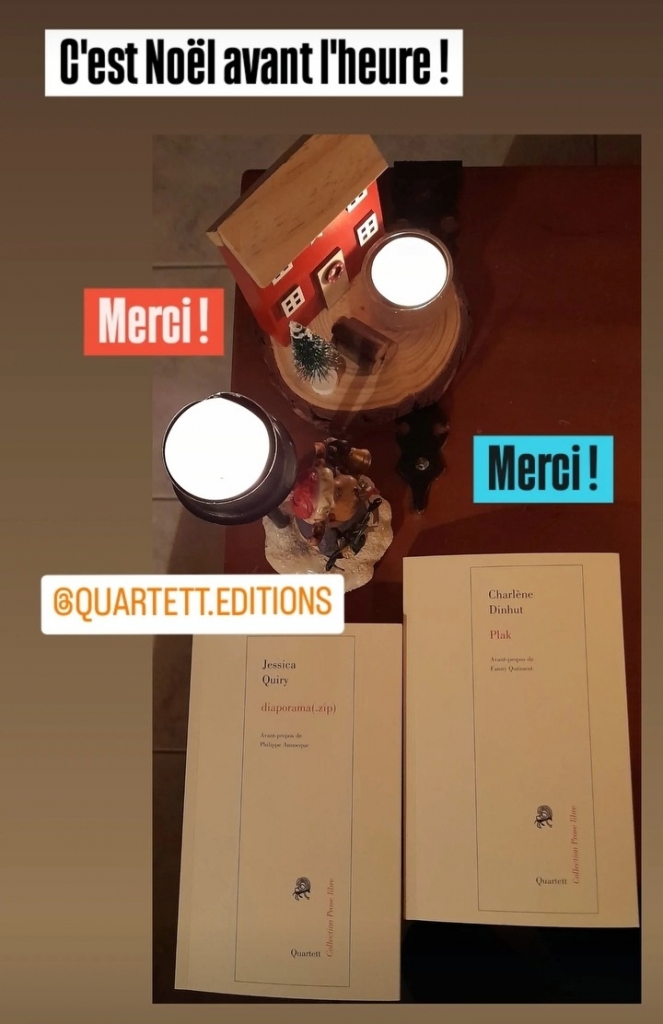
Ce matin, levé à 4 h 40, une fois le café fait (au piston), je me suis installé dans le fauteuil de la bibliothèque pour y poursuivre la lecture de Plak de Charlène Dinhut ; je reparlerai de ce livre, qui m’évoque à la fois le vieux film Les Gaspards (un effroyable nanard des années 70, il faut le dire (mais mythe familial)) et, pour l’écriture, autant Wittig que Savitzkaya.
J’ai reçu ce livre samedi, avec l’autre parution de janvier dans la collection Prose libre des éditions Quartett, grâce à Fanny Quément, je suppose, vu qu’elle a préfacé Plak. Les deux livres sont dédicacés par les deux autrices, dont l’une m’a gentiment féminisé·e. Merci beaucoup aux éditions Quartett ; ce n'est pas si souvent que cela qu'on m'envoie des livres [photo : post Instagram de remerciements, 20.12.2025].
Plak, que j’ai bientôt terminé, me plaît beaucoup. Un groupe de femmes, dont on ne comprend pas bien le statut existentiel – apparemment, elles sont convaincues qu’en mourant elles partent vivre « en haut » –, vit dans les souterrains, sous une grande ville, en évitant de se faire repérer par les égoutiers. L’autrice s’amuse à esquisser une utopie féministe sans jamais s’embourber dans un récit réaliste ou dans une quête de vraisemblance.
(J’ai des copies à corriger, et j’aurais aimé aussi évoquer Animal totem, film vu hier soir au cinéma. Je peux aussi écrire ici qu'aujourd'hui ma tante a soixante-dix ans.)
Hier soir, j’ai achevé la lecture de My Brother. ——— Je me suis tardivement à lire les livres de Jamaica Kincaid que je ne connaissais pas, et je le fais en mode binge-reading, mais quel choc, celui-ci, encore. Claire a vérifié hier, et apparemment, six de ses livres ont été traduits aux éditions de L’Olivier. Mon frère a été publié au Seuil, dans une traduction de Jean-Pierre Carasso et Monique Huet, trois ans seulement après l’édition américaine, en 2001.
Assez différemment de ses nouvelles – que j’adore –, Kincaid écrit en spirales, en ellipses ; elle creuse, répète, fait sombrer le lecteur dans un blanc avant de revenir vingt pages plus loin, en l’approfondissant, sur un détail qui avait semblé tomber ex nihilo. Sans doute a-t-elle été influencée par Beckett (la première phrase de Mr Potter…), George Lamming ou Gertrude Stein, mais ça n’explique pas grand-chose. Ses livres ont une force propre, une énergie stupéfiante (j’emploie l’adjectif à dessein).
Voici une page de My Brother, parmi tant d'autres, stupéfiantes :
Once, when I was looking for a new dress to wear to a ceremony during which my husband would receive an award, I bought a white dress with blue stripes, a dress I liked (though it was not the dress I finally wore to the ceremony, I later bought a plain white dress and wore that to the ceremony) because it reminded me of a dress worn by children (though it was a dress my own daughter, ten at the time, would never wear, too childish, she would say), and perhaps I bought it because I was just becoming old enough (I was forty-six) to want innocence again and old enough to convince any observer that the appearance of innocence at my age was meant to be my actual innocence at the age when I was actually innocent. I bought this dress; it had an Empire waistline, it had gathers under the breast, the length of the skirt came to just above my ankles. It was this dress I wore to my brother’s funeral. I bought it at the moment I was thinking of celebrating the honor my husband had been given, but it was that dress I wore to my brother’s funeral; and at the time I wore it to his funeral I thought to myself, I will never wear this dress again, I can never wear this dress again, and as I write this, it is true: 1 have never worn that dress again. I tried to give it away, but the person to whom I tried to give the dress was too old for it, she was sixty-one years old and was too short for it, the skirt dragged on the floor, and she was too stout for it, the zipper in the back would not go above the point that was her waist. And the airplane I flew on to his burial was blue, and the sky in which the airplane flew was blue, and there was the white of the clouds; and the water surrounding the land, the ground in which he was buried, that water was blue, and that water, the water surrounding the land in which he was buried, was sometimes flecked with white, the foam caused by the rush of the waves as they dashed against the shore. But the color blue did not run through all my memories, or all my experiences; on the whole, every scene, every memory remained itself, just itself, and sometimes a certain color might make memory more vivid and sometimes again, not so at all, just not so at all; sometimes a memory is without color, a dream is often like that, without color, but the absence of color does not mean an absence of truth, or truth in a way that one could understand as not a falsehood.
07:03 Publié dans 2025, Lect(o)ures | Lien permanent | Commentaires (0)